When people think about the role of teachers, they imagine classrooms, academic subject lessons, and exams.
But for children and young people with vision impairment, a Qualified Teacher of Children and Young People with Vision Impairment (QTVI) is essential.
These specialists provide tailored teaching and support that not only helps learners succeed in school but also equips them with vital skills for life.
Creating a skillset for learning and living
QTVI teachers bring a disability-specific skill set that goes beyond what mainstream educators are trained to provide. Their work is not about delivering the curriculum but about enabling access to the curriculum.
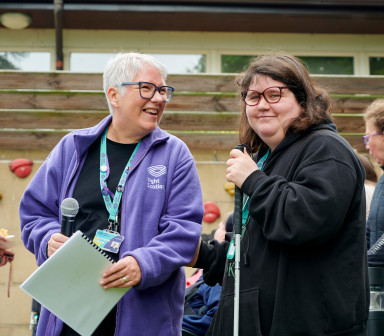
Pam Young is a QVTI teacher at the Royal Blind School and a braille subject specialist. Pam explains more:
"It’s a unique approach to learning and teaching where we have responsibility for supporting young people with sight loss to access learning. We aim to provide an appropriate learning environment with the necessary support and adjustments for all learners with sight loss, including young children and children and young people with complex additional support needs. Whether teaching braille and assistive technology or supporting early expressions of awareness and choice, we hope that, over time, our learners will acquire a bank of skills that will enable them to access the curriculum as independently as possible."
Filling in the gaps for development and growth
For sighted children, visual observation and real-life experiences help shape their concept development. For a child with vision impairment, these everyday concepts often need to be explicitly taught. QTVI teachers step in early, sometimes from infancy, to help fill in gaps in concept development. Early identification and specialist support are crucial and often life-changing for children who are born with or develop visual impairments.
The role of a QTVI extends beyond the classroom; they also work with families, equipping parents with knowledge related to their child’s learning which, in turn, encourages them to feel more confident and leads to their child developing a greater sense of autonomy and independence.
“Before a child can learn to read or write, they need to understand the world around them. We help them build that foundation by providing real-life experiences and access pathways that support understanding. We also support mainstream teaching colleagues who are working with young people with sight loss to develop teaching strategies and approaches that enable them to ensure these learners have equitable access to the curriculum alongside their mainstream peers.”
A partnership in learning
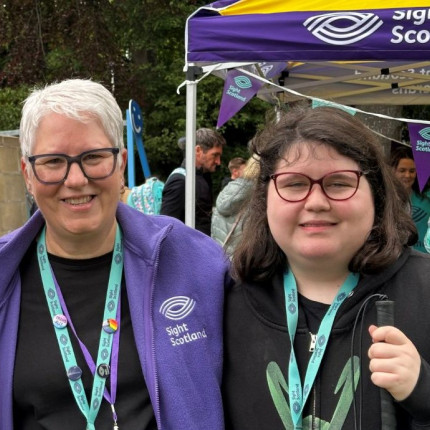
Pam and Jemima developed a strong bond during Jemima’s time at the Royal Blind School, built on Jemima’s deep commitment to learning braille and Pam’s dedication to supporting her journey.
Jemima came to braille later in her school career. She initially attended the Royal Blind School just two days a week, eventually progressing to a full-time placement with a clear goal: to regain independent access to literacy by learning to read and write braille.
“Jemima is one of the most committed braille learners I’ve taught. She had already built a strong literacy foundation and was so focussed and determined to acquire braille as a new way to access literacy. As her braille skill set grew, so too did her confidence. Braille gave her a voice, providing her with the confidence to speak up and to advocate for herself. She took ownership of her learning, and it was a joy to witness.”
Today, braille is woven into every part of Jemima’s life, from reading and writing to aspects of independent living.
Her story is a powerful example of how QTVIs do more than teach; they create opportunities, build confidence and help young people find their voice.
You may also be interested in
A story of independence, friendship and a brighter future
Jemima, who has Bardet-Biedl Syndrome and Retinitis Pigmentosa, was previously isolated at mainstream school. But her life changed when she began placement at Sight Scotland's Royal Blind School.
Life-changing support from Royal Blind School transforms Rocco’s life
Fifteen-year-old Rocco Wood was born three months premature, weighing just 985 grams. Due to complications at birth, he developed quadriplegic cerebral palsy and is visually impaired.