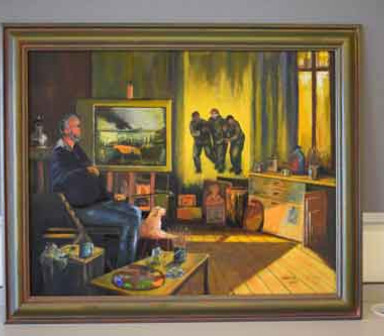
Charles Bonnet syndrome (CBS) is a very common condition following sight loss. CBS causes people who have lost a lot of vision to see things that aren't really there, known as visual hallucinations.
Many people find these hallucinations frightening, and are wary of telling family and friends about it in case they assume it is due to cognitive deterioration.
Katrina Campbell, a Rehabilitation Officer with Sight Scotland Veterans, offers expert advice on the condition and how to cope.
Support for people experiencing Charles Bonnet Syndrome
Our Vision Rehabilitation Specialists offer 1-2-1 support and run peer-led support groups over the telephone for anyone experiencing Charles Bonnet Syndrome.
Our peer-led support groups usually run monthly on a Thursday at 1:00pm, and provide an opportunity to share personal experiences, ask questions, and discuss the physiological aspects of CBS. We also offer coping strategies and a mindfulness/relaxation recording.
If you would like to find out more about the support on offer or join one of our support groups, please contact our Information Line on 0800 024 8973.
Charles Bonnet Syndrome symptoms
Charles Bonnet Syndrome (CBS) is a common condition following sight loss and can also occur where there is a further deterioration in vision. Unfortunately, there are some pockets within the medical profession where it is still relatively unknown. Since 2019, CBS has had a coding in the World Health Organisation’s ICD 11. It is now considered a condition in its own right. CBS is not a mental health condition or a form of dementia.
Hallucinations
CBS causes visual, silent hallucinations. The hallucinations vary greatly from person to person. The hallucinations might involve vivid and colourful images detailing people, places, animals, or even events. However for some people they can be a simple repetitive pattern such as brick wall pattern, overlay of a road map, or chicken wire pattern. Many people experience benign, gentle and non-intrusive visions. However, for others sadly their visions can be distressing such as rats or spiders crawling on the floor or across dinner plates or gargoyle-like faces.
Research into CBS suggests that when we see real things around us, the information received from the eyes stops the brain from creating its own pictures. When you lose your sight, however, your brain does not receive as much information from your eyes and as a result the brain can fill in these gaps in visual information by releasing new fantasy pictures, patterns or old pictures that it has stored. When this occurs, you experience these images stored in your brain as hallucinations.
Visual hallucinations, however, can be experienced by other conditions. Infection can cause delusion where a person can believe to see something that is not present. Lewy Body’s dementia can also sadly give rise to visual hallucinations. The important thing to note is that CBS hallucinations are visual only and the person is aware that they are not real. There is no auditory feedback (hearing voices) from a CBS visual hallucination nor is there a touch sensation.
Frequency and onset
CBS tends to begin in the weeks and months following a deterioration in sight, however it can occur at any time. People experience different frequency and periods of CBS, some for a few weeks whist others had hallucinations for years. There is no fixed rule for the frequency or prevalence of these visions.
Whilst there is a higher incident rate of acquired sight loss/impairment in the older adult population this does not mean that CBS is an age-related condition; it is a sight loss related condition. Children with congenital sight impairment and later in childhood sight loss can also experience CBS visual hallucinations.
Causes of Charles Bonnet Syndrome
CBS can be experienced by all ages and irrespective of their eye condition although those with cataracts are less likely to experience CBS due to very slow progression rate of the condition.
Stress, isolation and anxiety
Sight loss itself can cause anxiety, fear and loneliness, but when CBS is experienced, the isolation, even from family members, can exacerbate the downward turn in quality of life. Isolation and stress can exacerbate CBS, so it is important to have options to discuss your CBS visions with family, friends, a visual impairment professional or medical professional.
Stress and anxiety can also alter and increase the type of hallucinations individuals experience. Some people report there are certain times of the day when they are perhaps tired or just relaxing.
Lighting conditions
Some recent research of a small study sample discussed that there may be an increase in CBS visions in dimmer lighting conditions. It is thought this may due to the signal to noise ratio being altered i.e. as vision changes in lower lighting levels, the noise ratio (auditory noise and difficulty to see) increases. The brain tries to fill in this gap of the signal being reduced from lighting levels being dimmed and therefore a CBS/visual hallucination occurs.
This research further suggested that there is an Alpha signal in the visual cortex. Just prior to a vision being experienced, this signal drops in its frequency. When a vision ends, this signal returns back to its normal level. EEG records have shown the presence of this signal and as a result has provided very early start to new clinical evidence of CBS. This evidence is required to demonstrate to clinicians the real existence of CBS.
How do doctors diagnose Charles Bonnet Syndrome?
There isn't one test that your doctor can do to determine if you have CBS. Much of their ability to diagnose will be from talking with you about you sight condition and reviewing the onset of your hallucinations in relation to any changes in medication or a blood test to ensure there is no sign of infection.
If you are experiencing visual hallucinations, it is important to discuss this with your family and to make an appointment with your doctor to discuss as some medications may need to be reviewed. Many people report that when they understand that these visual hallucinations are part of their sight loss condition that it provides reassurance and can aid the reduction of the feelings of anxiety or isolation.
What does Charles Bonnet Syndrome feel like?
When hallucinatory symptoms of CBS occur, even when they are not of anything particularly frightening, they can be upsetting and it’s natural and quite common for people to feel upset or anxious just by having the experience of a hallucination of something which isn’t real.
Experiences of Charles Bonnet Syndrome
People who have experienced such hallucinations after sight loss explain:
- "I always thought that telling people I was seeing things would make them think I was going crazy."
- “I was stressed out that my wife would think I was telling her I had the early signs of dementia, if I shared what I was seeing. I didn’t want to worry her, so I suffered in silence.”
One person told us of experiencing seeing snakes swarming his living room floor. He felt forced to keep his feet firmly on the sofa, out of danger.
Treatments for Charles Bonnet Syndrome:
There is no one treatment for CBS, with most advice focusing on management of the condition.
- The most powerful impact on managing your CBS visions is knowledge and understanding. Knowing the cause of your symptoms means you can take control of the hallucination - whether this means ignoring it or acknowledging it. Sight Scotland Veterans Vision Rehabilitation Specialists can offer advice and support. Sight Scotland Veterans facilitate CBS peer led discussion support groups which offer a fantastic support base to discuss feelings and experiences with others also experiencing CBS either face to face or by telephone. You can contact our Support Line to discuss this further.
- There is a varied response to eye movement exercises. These can include blinking exercises, closing eyes, and resting eyes.
- Drug related treatments for CBS have not proved to have significant impact and there are concerns about being on medication to reduce visions which could interact or impact on other conditions.
You can find some helpful tips for settling a Charles Bonnet Syndrome visual hallucination in our dedicated section at the bottom of this page.
Coping with Charles Bonnet Syndrome hallucinations
It can be extremely distressing to have your life disrupted constantly by vivid, silent, visual hallucinations. There are measures which can be tried to dispel the hallucination when it occurs. However, everyone is different and some strategies work better than others.
Some people find they experience CBS first thing in the morning or at dusk when the lighting isn’t as good – so switching on a light or even flicking a light switch is enough to dissipate the hallucination. Blinking, moving your eyes or reaching out to touch the hallucination can have the same effect.
Though there is no cure for CBS, many people find the hallucinations settle down over time as their brain adjusts to the vision loss. However, some people do continue to see hallucinations so letting people know that you have this problem or talking about it with others who have shared the experience should offer some peace of mind.
Sight Scotland Veterans runs a Charles Bonnet Support Group, which takes place once a week for 4 weeks via telephone. These groups offer an opportunity to share your experiences with others, discussing coping strategies and a recording from Judith Potts, founder of Esme’s Umbrella. The groups have proven to be very supportive and helpful for our veterans. If you wish further information, please speak to your Independent Living Worker or call 0800 035 6409 for Sight Scotland Veterans.
Charles Bonnet Syndrome FAQs
At present we believe changes sight levels, changes in lighting conditions (coupled with a change in sight) such as artificial light in the house or environmental like darker morning/evening in autumn and winter, tiredness, stress and anxiety can all trigger or increase CBS visions.
This varies person to person. The hallucinations might involve vivid and colourful images detailing people, places, animals, or even events. However for some people they can be a simple repetitive pattern such as brick wall pattern, overlay of a road map, or chicken wire pattern. (see end of document for visual representation). Many people experience benign, gentle and non intrusive visions. However for others sadly their visions can be distressing such as rats or spiders crawling on the floor or across dinner plates or gargoyle like faces.
No, however it can be distressing and support for the feelings connected to CBS is important. We encourage people to discuss this with their family, doctor and Visual Rehabilitation Specialist (connected to Sensory Impairment teams or here at Sight Scotland and Sight Scotland Veterans).
Early advice used to suggest that following a change in sight that CBS could be experienced for approx. 6mths, however we are now aware that this is not the case. Some people can experience visions beyond 3yrs. However not all people who experience visual hallucinations from CBS are unsettled or anxious about these visions. Please seek support if you your CBS visions are affecting your life and the enjoyment of life.
No. It is a condition that is managed by numerous options. These are discussed in Treatment for CBS section. For many people they will experience CBS visions for a period of time in their life and never experience them again. For others, their CBS visions may settle over time and re-occur again with a change in their vision loss. It varies from person to person.
Charles Bonnet is not a brain injury. It is connected to the impact of sight loss/impairment. A stroke can cause an impairment or injury to the brain. As a result of stroke, your vision can be impacted, and you can experience CBS visions.
No. They are two separate stand-alone conditions. CBS is a sight loss related condition. Dementia is a syndrome (a group of related symptoms) associated with an ongoing decline of brain functioning. However, a person can have a diagnosis of Dementia and a diagnosis of CBS also. In this situation support from Dementia support groups, your doctor and a Vision Rehabilitation Specialist would be very helpful.
Read up on the condition. Talk with your loved one and ask them if they have ever experienced CBS visual hallucinations. Not all people with a sight loss/impairment diagnosis will experience CBS. The prevalence of CBS is thought to be as low as 10% to as high as 60% in those with diagnosed sight loss. Of those with CBS symptoms, most continue in their daily lives with minimal impact.
For those who are experiencing difficulties with their CBS symptoms, Sight Scotland Veterans hold CBS peer led discussion support groups which offer a fantastic support base to discuss feelings and experiences from these visual hallucinations. These are led by Vision Rehabilitation Specialists and facilitated on the telephone. Please contact the Helpline on 0800 035 6409 to discuss this further.
Tips for settling a Charles Bonnet Syndrome visual hallucination
Consuming real ginger - for example in ginger ale, tea biscuits, etc. - has been found to be helpful to some people with hallucinations. However, it is imperative to check with your doctor beforehand as ginger may interact adversely with certain medications.
Similarly to ginger, some people have found that omega 3 supplements help ease their symptoms. Recent reports also suggest that legal CBD oil and capsules may be of some help too. Speak to your GP for personalised advice and guidance.
Establish where the hallucinations occur more often – maybe in a particular room or part of the garden. Of course, it may not be possible to avoid an entire area, especially if it is in your own home, but knowing where they often happen can reduce the stress they cause and you can try some of the coping strategies that we discuss above, such as increasing lighting and eye movements.
- Look from left to right about once every second for 15 seconds without moving your head. If the hallucination continues, have a rest for a few seconds and then repeat the eye movements. You may need four or five repeats of the eye movements to have an effect but there is no point in continuing beyond this if there is no benefit.
- Reach out towards the hallucination, try and touch it or sweep your hand to brush away the image.
- Walk into another room or another part of the room.
- Turn your head slowly to one side and then the other. Dip your head to each shoulder in turn.
- Change whatever it is you are doing at that moment – turn off/turn on the television/radio/music.
- Change the light level in the room. It might be the dim light that is causing the hallucinations. If so, turn on a brighter light – or vice versa.
- Concentrate on your breathing. Breathe in and out slowly to calm your pulse-rate. Count as you do so.
- Many people find relaxation techniques such as mindfulness helps.
Isolation and stress can exacerbate the condition, so it is important to discuss your CBS visions with family and friends, or a doctor or carer who can provide support.
Support and advice for Charles Bonnet Syndrome
Sight Scotland and Sight Scotland Veterans are here to support those with Charles Bonnet Syndrome, as well as other eye conditions. We can also provide advice, guidance and support to family members and carers of those with eye conditions.
Reach out to us and get in touch through our dedicated freephone Support Line or by completing our online enquiry form today.
You may also be interested in
Charles Bonnet Syndrome: Marjorie's story
Veteran Marjorie Ramage shares her experiences of little-known condition Charles Bonnet Syndrome, which causes visual, silent hallucinations to occur as a result of sight loss.
Glaucoma: Treatment, Symptoms & Diagnosis
Learning more about Glaucoma. Sight Scotland Veterans rehabilitation officer, Katrina, offers expert advice on coping with a glaucoma diagnosis.
Age-Related Macular Degeneration (AMD): Treatment, Symptoms & Diagnosis
Learn about age-related macular degeneration (AMD), its causes, symptoms, and treatment options in Scotland. Get expert advice and support today.