When people talk about accessibility, they often think about the physical changes that make places easier to navigate - but if we stop there, we miss half the picture.
True inclusion is not just about changing buildings; it is about changing minds.
Read more in this blog by Callum Lancashire, Engagement Manager for Sight Loss Councils in Scotland.
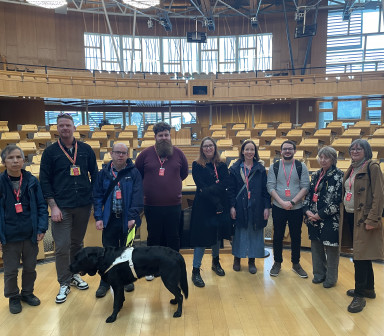
Many people still see visual impairment as a problem with the person. The medical model treats it that way. But the social model shows the real challenge comes from the barriers around us – in buildings, street design, online, or in people’s attitudes. Even the most accessible location will fall short if staff do not know how to guide someone safely, or if vision impairment is seen as a limitation rather than part of human diversity.
As Engagement Manager for Sight Loss Councils in Scotland, I see every day how much attitudes matter. I also know this personally. I lost my sight at fifteen after an accident caused macular degeneration. At the time, I had no support and no one to guide me through the changes in my life. My mental health suffered. It was only when I met others with vision impairment and shared experiences that I realised I could still live a full and active life. What I needed was not pity but understanding.
That understanding is exactly what Sight Loss Councils aim to create. We meet monthly, bringing together visual impaired volunteers to influence change locally and nationally. We use our lived experience to champion the rights of people with visual impairment and push for greater accessibility, inclusion and equality.
Currently active in Edinburgh, Glasgow and Dumfries and Galloway, our councils are delivered in partnership by Sight Scotland, Sight Scotland Veterans and Visibility Scotland, with funding from Thomas Pocklington Trust.
Changing attitudes is at the heart of the work we do at the Sight Loss Councils, where we support members to navigate daily barriers and speak up for the changes they need.
Sight Loss Councils have been proud to support the success of Sight Scotland and Sight Scotland Veterans’ Fair Rail Campaign, which directly led to the launch of a Scotland-wide pilot scheme giving free rail travel to companions of blind and partially sighted passengers. From April 2025, anyone with an Eye Plus One Scottish National Entitlement Card can travel with a companion at no extra cost.
The Fair Rail Campaign highlights why understanding and supporting the needs of people with visual impairment is just as important as the infrastructure in place. Even the most accessible train station in the world can be a major hurdle for someone with visual impairment. Getting on a train safely requires self-confidence, planning, and support - and until recently, this support was inconsistent and costly. The new pilot scheme is a clear example of what can happen when attitudes change at every level.
Inclusion is not about doing something extra for disabled people, it is about removing unnecessary barriers so that everyone can take part in everyday life.
Sight Loss Councils launch in Dumfries and Galloway
A new Sight Loss Council has launched in Dumfries and Galloway, offering a unique opportunity for local people with visual impairment to have their voices heard.
You may also be interested in
Lived Experience
Real-life experiences of those with sight loss and/or visual impairment give us an informed perspective from those directly affected by these conditions, so we're better able to influence policy and create campaigns that provide real, needed support.
Our Campaigns
Our dedicated Sight Scotland policy team work with blind and partially sighted people to campaign for positive change. Read more about our campaigning work here.