On 11 March 2026, Fiona Hyslop MSP, the Cabinet Secretary for Transport, announced at the Cross-Party Group on Visual Impairment that free companion rail travel for severely sight impaired or blind people in Scotland will become permanent.
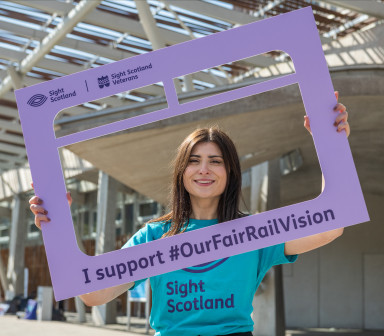
This is a victory that belongs to everyone who played a part in the campaign — the veterans who first raised the issue and never let it go, every person who signed the petition, completed a survey, gave evidence, attended an event, or told us about a journey they couldn't make.
It’s about the politicians from every party who listened to those voices, and took action make the pilot happen. Together you made the change.
We're also grateful to the Scottish Government, Transport Scotland and ScotRail for working with us to design, deliver and evaluate the pilot — a genuine example of what's possible when policymakers listen to lived experience.
How it started
This Fair Rail campaign began with veterans at Sight Scotland Veterans who raised it as a straightforward equality issue: severely sight impaired or blind people were paying for a ticket for a companion on every rail journey — a cost that for many made train travel unaffordable. However, without a companion to help them navigate stations and platforms safely, rail travel was simply not an option.
Under existing concessionary travel schemes, severely sight impaired or blind people who hold an Eye +1 National Entitlement Card could already have a companion travel with them for free on buses and ferries — but not on trains.
Our veterans at Sight Scotland Veterans brought this issue directly to us, and in 2022 we launched the Fair Rail Vision campaign, calling on the Scottish Government to establish a consistent national policy.
Taking the campaign to Parliament
We gathered signatures for a petition to the Transport Minister, gave evidence to the Citizen Participation and Public Petitions Committee, and promoted the campaign at political party conferences, securing cross-party support along the way.
Our veterans also found creative ways to bring the issue to life, building props — including a big ticket machine and a train — and using them at engagement events across Scotland to get the attention of policymakers and the public.
Graham Simpson MSP championed the cause through a motion backed by 32 cross-party members and a Members' Debate in the Scottish Parliament, after which then Transport Minister Jenny Gilruth MSP extended her support for the campaign. The issue was subsequently included in the Scottish Government's Fair Fares Review, published in March 2024, which committed to developing a pilot project to extend free companion rail travel on ScotRail services.
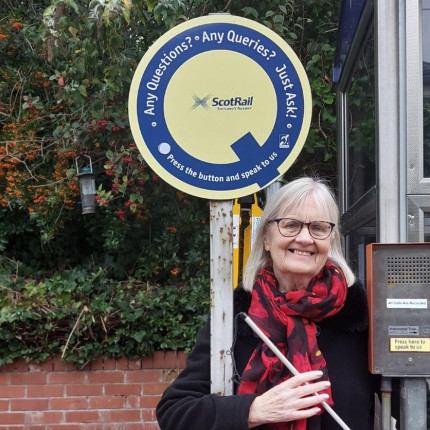
On 1 April 2025, Kaukab Stewart MSP, Minister for Equalities, officially launched the year-long pilot scheme, and Transport Scotland carried out a thorough evaluation in partnership with Sight Scotland, Sight Scotland Veterans and ScotRail.
What the evidence showed
According to Transport Scotland's Blind Companion Free Rail Travel Pilot Evaluation Report (March 2026), a total of 1,482 cardholders responded to the follow-up evaluation survey — up from 214 at baseline — reflecting both the scale of interest and direct outreach to all 8,010 eligible cardholders.
Of those who had travelled by rail since the pilot launched, 84% had used the free companion scheme, and 94% said it was easy to access. At least 95% of users reported positive effects on their independence, mobility, confidence, travel costs, and safety and accessibility.
The scheme also changed how people travel. Among those whose rail use had shifted, 84% were making more trips, 69% were travelling to new destinations, and there was clear evidence of modal shift — 54% were now making journeys by rail that they would previously have taken by bus, and 43% were replacing car journeys. Meanwhile, 60% of those who had sometimes used the Passenger Assistance Service said they were now less likely to need it, because they had a companion with them instead.
Transport Scotland's baseline study, conducted in February 2025 ahead of the pilot launch, had found that cost was the most commonly cited barrier to rail travel among those who never used the train. The evaluation confirmed the scheme addressed that directly.
Feedback gathered by us echoed these experiences. People described a renewed sense of freedom, with many travelling to places that previously felt out of reach. One person told us: "This scheme gives me a great sense of freedom — to go up to the central belt I was dependent on bus." Others highlighted the social impact, with one saying: "It has opened my social life now that I can take a companion."
Train travel was frequently praised as quicker, more reliable and more predictable than buses, which made people feel safer and more confident — particularly at busy times.
In their own words
One survey respondent summed up what many told us:
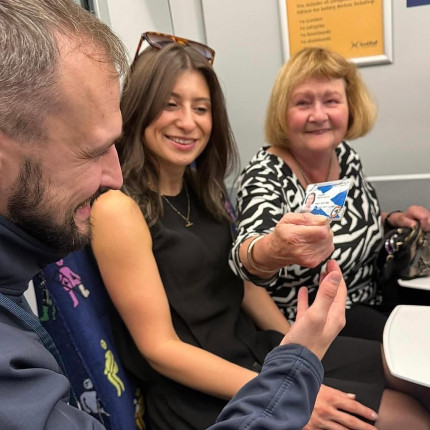
"It's made me more eager to do things and go new places. Having someone there and not feeling you're attaching additional cost to their day gives a sense of freedom."
"I have used it regularly with my wife and we have travelled all around Scotland. It has opened so many doors for me. The benefit of having a companion is huge, and this pilot makes it affordable, but even more importantly, it makes it safer."
"Since the pilot launched, I feel like I have started living again. I have travelled to Edinburgh for dementia meetings with my daughter, I have visited Inverness with my support worker. Being able to get out and about safely, without worrying about the cost, has been life changing."
"This free companion rail travel pilot makes travelling so much safer and takes away the stress and strain of using the train. It just removes the anxiety."
Craig Spalding, Chief Executive of Sight Scotland and Sight Scotland Veterans, comments:
“We are delighted that the Scottish Government has made free companion rail travel a permanent policy - a major step towards making train travel truly affordable and accessible for everyone. After more than three years of campaigning, this is a huge victory for our campaigners, service users, and our External Affairs and Campaigns team, whose hard work has made this possible.
“Through our Fair Rail Campaign, we have helped amplify the voices of visually impaired people and highlight the barriers they face when travelling. The research shows just how much this scheme means to people and the major impact it has had on their independence, confidence and day to day quality of life. This decision will be genuinely transformative, improving both inclusivity and affordability.”
Anne Dignan, from Edinburgh, who is deafblind and has macular degeneration, comments:
“This news is genuinely life changing. Knowing that free companion rail travel is here to stay gives me confidence and freedom I didn’t have before. I can plan trips without worrying about the cost of a companion ticket, travel more often, and explore new places that I couldn’t before without the extra financial burden.
“Thanks to Sight Scotland, Sight Scotland Veterans and the tireless work of campaigners, free companion travel means independence, inclusion and the opportunity for people like me with sight loss to access rail travel right across Scotland.”
Agnes Houston, 76, a former army nurse from Coatbridge, who lives with both dementia and visual impairment, says:
“I am overwhelmed by this news. It means so much to me. Over the past year it has genuinely changed my life, and I was becoming quite worried about the pilot ending. Because of my visual impairment and dementia, I can no longer travel alone, especially over long distances, and I simply couldn’t afford to pay for a companion.
“The difference the free companion rail travel has made to my mental health is extraordinary. Being able to go out and do the things I enjoy, without the constant worry about how I’m going to get there, is something I struggle to put into words. When someone with a visual impairment travels alone, they are constantly on edge, worrying about where to get off, whether they can manage safely. It is so stressful that many of us just stop travelling altogether. But with a companion, we can relax, feel safe and enjoy the experience.”
Cabinet Secretary for Transport Fiona Hyslop said:
“I’m pleased to confirm that from 1 April 2026, free companion rail travel for visually impaired people will become a permanent offering. This change will support around 8,000 visually impaired National Entitlement Cardholders who rely on ScotRail and Caledonian Sleeper services.
“Over the past year, the pilot has clearly shown the profound impact that affordable, accessible rail travel can have for severely sight impaired or blind people. We’ve seen people travelling more often, gaining confidence, and needing less staff assistance. Feedback from Sight Scotland, Sight Scotland Veterans, and – most importantly – passengers themselves has been overwhelmingly positive.
“By making this scheme permanent, we’re opening up greater access to work, education, communities, and everyday life in ways many of us take for granted. This decision strengthens independence, reduces isolation, and improves quality of life, and it reflects our wider commitment to ensuring Scotland’s railway is accessible, affordable, and welcoming for everyone who depends on it.”
Phil Campbell, ScotRail Customer Operations Director, said:
“We’re delighted the Scottish Government’s free companion rail travel scheme for visually impaired people is being made permanent and proud to be able to play our part in improving the customer experience for people who are blind or have a visual impairment.
“This is a major step towards empowering people to be able to travel with confidence and independence, making train journeys safer and more welcoming for everyone. ScotRail is committed to ensuring the railway works for all of our customers, and the scheme is part of our wider efforts to improve accessibility across our network.”
A model for collaboration
This outcome is the result of effective collaboration between the Scottish Government, Transport Scotland, ScotRail, and Sight Scotland and Sight Scotland Veterans. It demonstrates what's possible when government departments work with charities and the people they serve to embed equality into public services — and it offers a strong model for how future policy can be shaped.
Recognition
The Fair Rail campaign was also a finalist in the Health and Social Care Alliance Scotland's Self Management Awards 2025, in the Sensory Impairment: Positive Self Management category — recognition of the campaign's role in supporting people with sight loss to live more independently and on their own terms.
Thank you
To everyone who made this happen: thank you. To the veterans who first raised this issue and never let it go. To everyone who signed the petition, attended engagement events, gave evidence at committee, spoke to their MSP, or told us about a journey they couldn't make. To everyone who completed the surveys, took part in focus groups, and shared their experiences so that the case for change was undeniable. To the MSPs and policymakers who listened, and to the civil servants and rail staff who made the pilot work.
This campaign was always about making sure that severely sight impaired or blind people in Scotland can travel by train with the same freedom, safety and dignity as everyone else. From today, that's no longer a pilot — it's permanent, and it happened because people with lived experience spoke up and refused to be ignored.
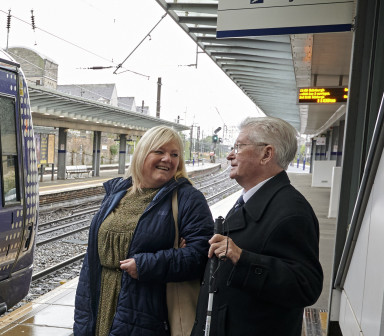
Fair Rail Campaign
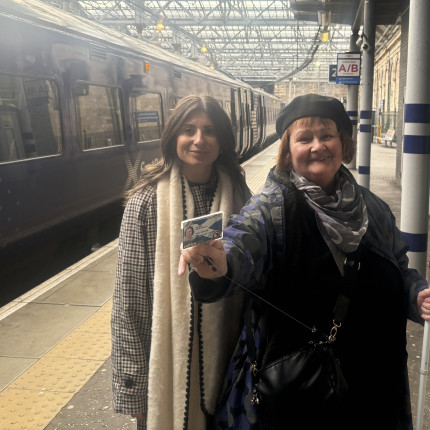
The Sight Scotland Fair Rail Campaign is calling for free rail travel across Scotland for companions of those with visual impairments.