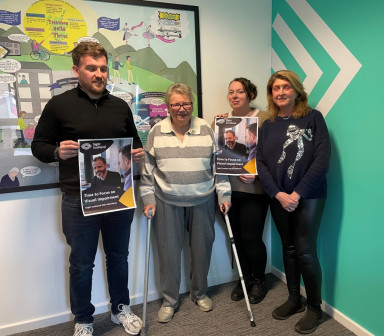
Ahead of the Scottish Parliament elections on the 7th of May Sight Scotland and Sight Scotland Veterans hosted an online hustings aimed at ensuring visually impaired people from across Scotland could ask candidates about the issues that matter to them.
The event brought together candidates from six parties to answer questions on healthcare, rehabilitation, accessible communities, public transport, and specialist education — all areas at the heart of our election manifesto.
Representing their parties on the night were Allan Petrie (Independence for Scotland Party), Heather Greig (Scottish Conservatives), Isabel Ruffell (Scottish Greens), Daniel Johnson (Scottish Labour), Stuart McMillan (SNP), and Christine Murdoch (Scottish Liberal Democrats), with Sight Scotland’s Lived Experience Policy and Engagement Manager Nicoletta Primo in the chair.
What we discussed
The evening covered five main themes, drawing on questions submitted in advance by our audience as well as a live Q&A throughout.
A more detailed, accessible word document summary of the full discussion, covering each theme and candidate response, is available here, but a summary and the candidates closing statements are described below.
On eye healthcare, candidates were asked why waiting times remain so long and what their parties would do differently. There was broad agreement that the current situation is unacceptable, with debate ranging across funding levels, the future of specialist facilities, the role of community-based care, and the importance of involving people with lived experience in shaping services.
Vision rehabilitation prompted some of the most candid exchanges of the evening. All candidates acknowledged that support after a diagnosis of visual impairment is inadequate, with discussion focusing on the disconnect between health and social care, the real cost to society of failing to support people back into independence and employment, and the potential of peer-led approaches. An audience member from Dumfries and Galloway made the postcode lottery vivid and personal, explaining that her area had lost its low vision clinic following COVID and cuts — a reminder of how the policy decisions are affecting people's daily lives.
The discussion on accessible streets centred on floating bus stops, pavement maintenance, street clutter, and the importance of involving visually impaired people in planning decisions from the outset. Most candidates supported a moratorium on new floating bus stop installations, though views varied on the detail — with some arguing that infrastructure needs updating rather than pausing given the climate imperative around active travel, while others called for immediate improvements to crossing arrangements at existing stops.
Transport brought a mix of personal testimony and policy debate, with audience members sharing both positive experiences of bus and rail staff and practical frustrations, particularly around identifying buses at stops. Candidates discussed the case for bringing bus services under public control, the need for better announcements and signage, and the importance of retaining free companion rail travel for National Entitlement Card holders.
On specialist education, the discussion turned to the attainment gap facing visually impaired learners and the shortage of qualified teachers of visual impairment across Scotland. Candidates debated mainstreaming versus specialist provision, with strong agreement that the status quo is not working and that early intervention is critical.
What comes next
The Scottish Parliament election takes place on 7 May 2026.
If you have questions or thoughts on what we should be campaigning for, please get in touch using the button below.
And, as our Lived Experience Policy and Engagement Manager, Nicoletta, put it at the end of the evening — remember to vote.
Scottish Parliament elections 2026 party manifestos analysis
Scotland goes to the polls on 7th May 2026. We have gone through every major party manifesto and pulled together what each party is promising on eye health, disability rights, social care and equality — all in one place.
Your Voice, Your Vote: Scottish Parliament Elections 2026
The Scottish Parliament elections are coming up on 7 May 2026, and we want to ensure that everyone in our community can participate fully in our democracy.