A new survey is giving blind and partially sighted people across the UK the chance to share their experiences of accessing food packaging, helping to build the case for mandatory Braille labelling.
For many of us, picking up a packet of cereal, checking an expiry date or making sure we have bought the right yoghurt is second nature.
But for blind and partially sighted people, finding essential information on food packaging can be much more difficult, and often means having to ask someone else for help.
Now, a new survey is being launched by Sight Scotland, Disability Equality Scotland and partners to gather evidence about these everyday experiences and help make food labelling more accessible.
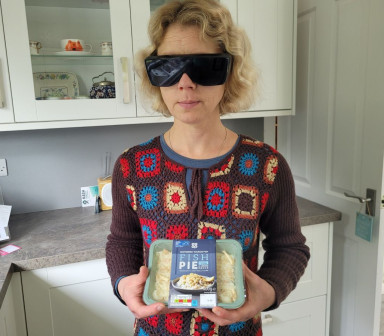
Have your say on accessible food labelling
The new survey is an opportunity for blind and partially sighted people across the UK to share their experiences of food packaging and help build the evidence for change.
If you are blind or partially sighted, we encourage you to take part in the survey and share your experience.
Complete the online Braille Food Labelling Survey here.
You can also visit our Campaign Page to access the survey in an alternative format.
Why accessible food labels matter
Research by Disability Equality Scotland in 2023 found that three-quarters of blind and partially sighted people find food labels inaccessible.
The new research will look at the challenges people face when identifying, storing and using food products. The findings will help inform Food Standards Scotland’s Business and Regulatory Impact Assessment and support discussions with UK Government departments, including DEFRA, about potential changes to food labelling policy.
For Veronica Whymant, 43, from St Andrews, better food labelling is about much more than convenience.
Veronica has lived with visual impairment all her life after being born prematurely. Her vision gradually deteriorated during her teens, and she was registered blind in her early twenties.
She believes everyone should have the same opportunity to make independent choices about the food they buy and eat.
“Braille labelling on food packaging would be revolutionary. It would give me more independence, less anxiety when shopping and greater confidence when preparing meals. Most importantly, it would allow me to make decisions for myself.”
“This isn't about convenience, it’s about dignity, equality and choice. No one should be denied the ability to confidently and independently make decisions about the food they buy and eat simply because information isn’t accessible.”
The difference Braille could make
Veronica says inaccessible packaging can create uncertainty around some of the most ordinary tasks.
“Food shopping is one of the areas where visual impairment can be surprisingly restrictive. I buy a lot of fresh food, but when it comes to packaged products such as yoghurt, cereal or biscuits, it can be difficult to know whether I’ve picked up exactly what I intended.”
While asking for help can be useful, Veronica says being able to identify products herself would make a significant difference to her independence.
“If I’m unsure, I have to ask someone nearby for help, and while people are always kind, I’m fiercely independent and would much rather be able to identify products for myself.”
At home, Veronica has developed her own systems to make everyday life easier. She carefully organises and catalogues the food in her cupboards and freezer so she knows where everything is.
But, as she explains, this can mean putting considerable extra effort into tasks that sighted people may take for granted.
“Having clear Braille labels would provide reassurance and confidence and remove so much uncertainty from daily life.”
Braille and technology can work together
Technology has opened up new ways for blind and partially sighted people to access information, but Veronica believes it should complement Braille rather than replace it.
“Braille sits alongside technology rather than against it. Apps and digital tools can be incredibly useful, but they are not always practical in every situation. Braille provides immediate, independent access to information.”
She also points out that technology is not equally accessible to everyone.
“People often assume technology has solved every problem for someone who is blind or partially sighted, but it can be expensive and depends on devices, software and internet access.”
For Veronica, Braille offers something particularly important: the ability to access information directly and privately.
“Braille allows you to access information directly, privately and independently, whether it's on medicine, food packaging, public signs or museum displays.”
A lifelong connection with Braille
Veronica first discovered the importance of Braille while studying German at university and spending a year teaching English at a boarding school for blind children in Germany.
She was given homework in Braille to mark and had to learn it quickly.
“Although my Braille is still quite basic, it has shown me the power of being able to access information independently. Having lost the ability to read print as a teenager, those moments of reading something for myself are incredibly valuable.”
She says accessible food labelling would be another step towards ensuring blind and partially sighted people can live with the same independence and choice as everyone else.
“This isn't about convenience, it’s about dignity, equality and choice. No one should be denied the ability to confidently and independently make decisions about the food they buy and eat simply because information isn’t accessible.”
Take the survey
By sharing what works, what doesn't and the barriers people face in everyday life, respondents can help ensure that the experiences of blind and partially sighted people are part of the conversation about the future of food labelling.
Together, we can help make sure that access to information on food packaging is not a barrier to independence, dignity and choice.
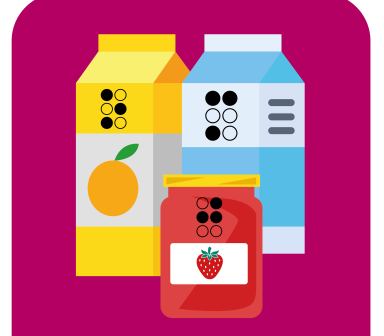
Accessible Food Labelling
Working with Oban and District Access Panel and Disability Equality Scotland, we have launched a Scottish Parliament petition urging the Scottish Government to create a statutory duty for businesses and retailers to provide braille labels on food pro
Our Campaigns
Our dedicated Sight Scotland policy team work with blind and partially sighted people to campaign for positive change. Read more about our campaigning work here.